OpenAI Presence is not the next software subscription an SMB should wait to buy. As of July 2026, it is a managed enterprise deployment for high-volume voice and chat workflows. Most smaller businesses can act now by choosing between ChatGPT Workspace Agents and a custom API workflow—with the choice driven by operational requirements, not model hype.
By QuickSummit · Updated July 27, 2026
Disclosure: QuickSummit has no affiliate relationship with OpenAI. Links to QuickSummit services promote our own consulting work.
What OpenAI Presence Is—and Is Not
Presence combines OpenAI models with policies, permissions, business-system integrations, simulations, evaluations, monitoring, escalation rules, and controlled releases. OpenAI describes it as a platform for governed agents handling repeatable, high-volume or high-stakes work—not as a chatbot builder or document-upload feature. Early supported channels are voice and chat. OpenAI’s Presence Help Center provides the clearest product boundary.
A Presence deployment begins with one defined job. Examples supplied by OpenAI include resolving billing problems, supporting insurance claims, and handling employee IT requests. The company determines which systems the agent may access, which actions it may take, and when a person must intervene. OpenAI says deployment then includes security review, simulations, acceptance testing, staged rollout, monitoring, and continued improvement.
As of July 27, 2026, OpenAI Presence is not a self-serve small-business product. OpenAI says it is a managed deployment in limited general availability for eligible enterprise customers, with access determined by workflow fit, implementation readiness, and available delivery capacity. Source: OpenAI Help Center.
The distinction matters because Presence is an operating model, not merely access to a better model. An SMB can reproduce parts of that operating model—scoped permissions, evaluations, approvals, logs, and escalation—without buying Presence.
Can a Small Business Buy OpenAI Presence Today?
Not through a public checkout page. OpenAI directs interested organizations to their OpenAI account team, and it does not publish a minimum contract, standardized implementation package, or rate card. Exact features, models, capacity, data handling, pricing, and service commitments are set during each deployment. OpenAI’s July 22 announcement says eligible enterprise customers receive deployments led by Forward Deployed Engineers and selected systems integrators.
For an SMB without an enterprise account relationship, “wait for Presence” is therefore not an implementation plan. There is no published date for self-service or small-business access.
OpenAI says Presence deployments are led by its Forward Deployed Engineers and selected global systems integrators. Pricing, implementation scope, exact features, capacity, data handling, and service commitments are defined for each deployment, so there is no public rate card. Sources: OpenAI’s announcement and Help Center.
Our position is straightforward: borrow the Presence deployment discipline now. Do not design around presumed future pricing or availability.
Presence vs. ChatGPT Workspace Agents vs. Custom API Workflows
| Option | Best fit | Public cost information as of July 2026 | Main tradeoff |
|---|---|---|---|
| OpenAI Presence | High-volume, governed voice or chat workflows for eligible enterprises | No public rate card | Managed expertise, but no self-service SMB access |
| ChatGPT Workspace Agents | Repeatable internal work using ChatGPT, Slack, files, apps, or schedules | ChatGPT Business starts at $20 per user per month billed annually, with 2+ users; $25 monthly | Faster setup, but less control over the runtime and user experience |
| Custom API workflow | Work embedded in a website, CRM, ERP, support system, or custom interface | Usage-based model and tool charges | Maximum control, but the buyer owns implementation and operations |
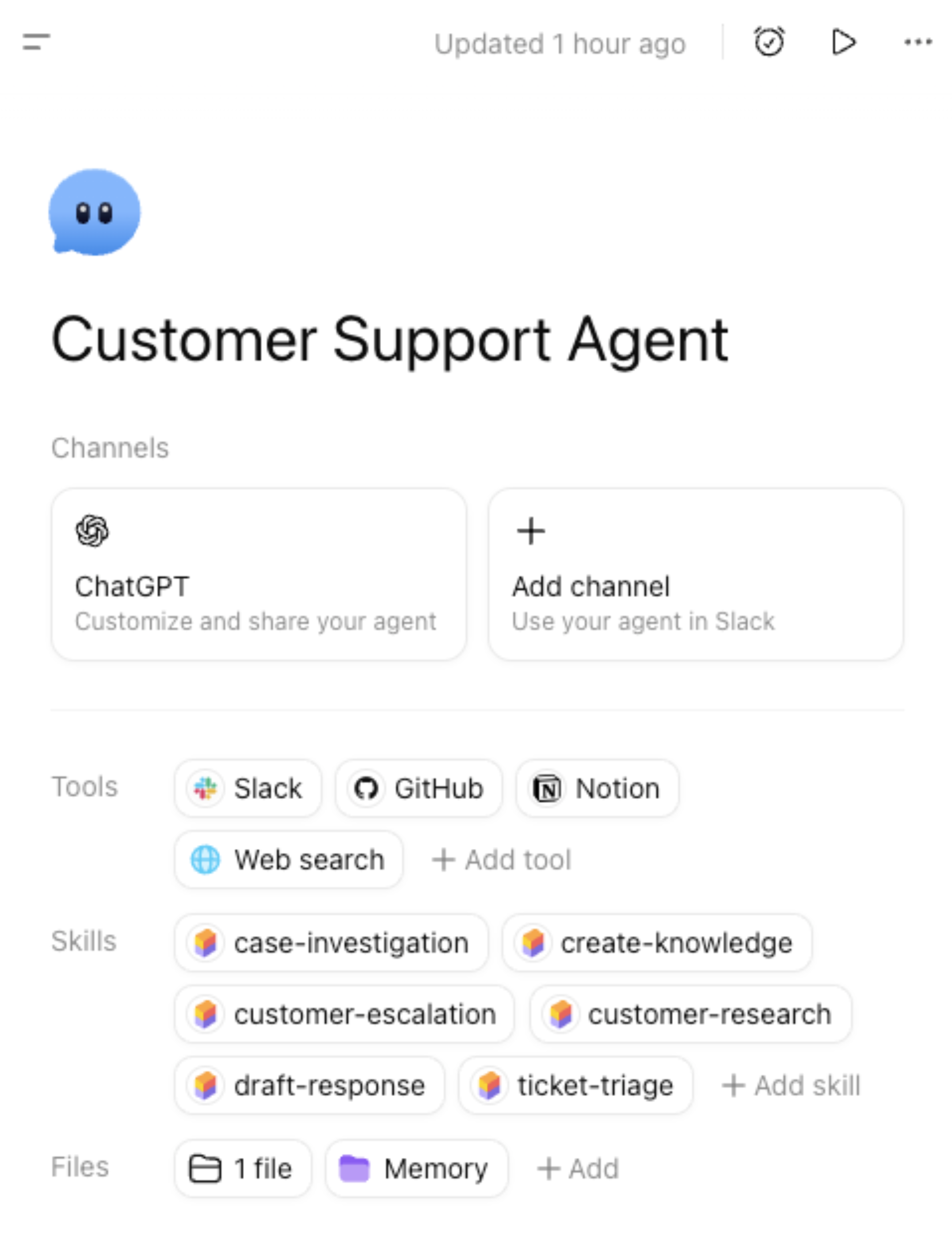
OpenAI says Workspace Agents are available in supported ChatGPT Business and Enterprise workspaces. A builder can assign instructions, files, skills, apps, custom MCP connections, schedules, Slack channels, and write-action approvals. Agents can also be triggered through an API. OpenAI’s Workspace Agents guide documents those capabilities, while current ChatGPT pricing lists the Business seat costs above.
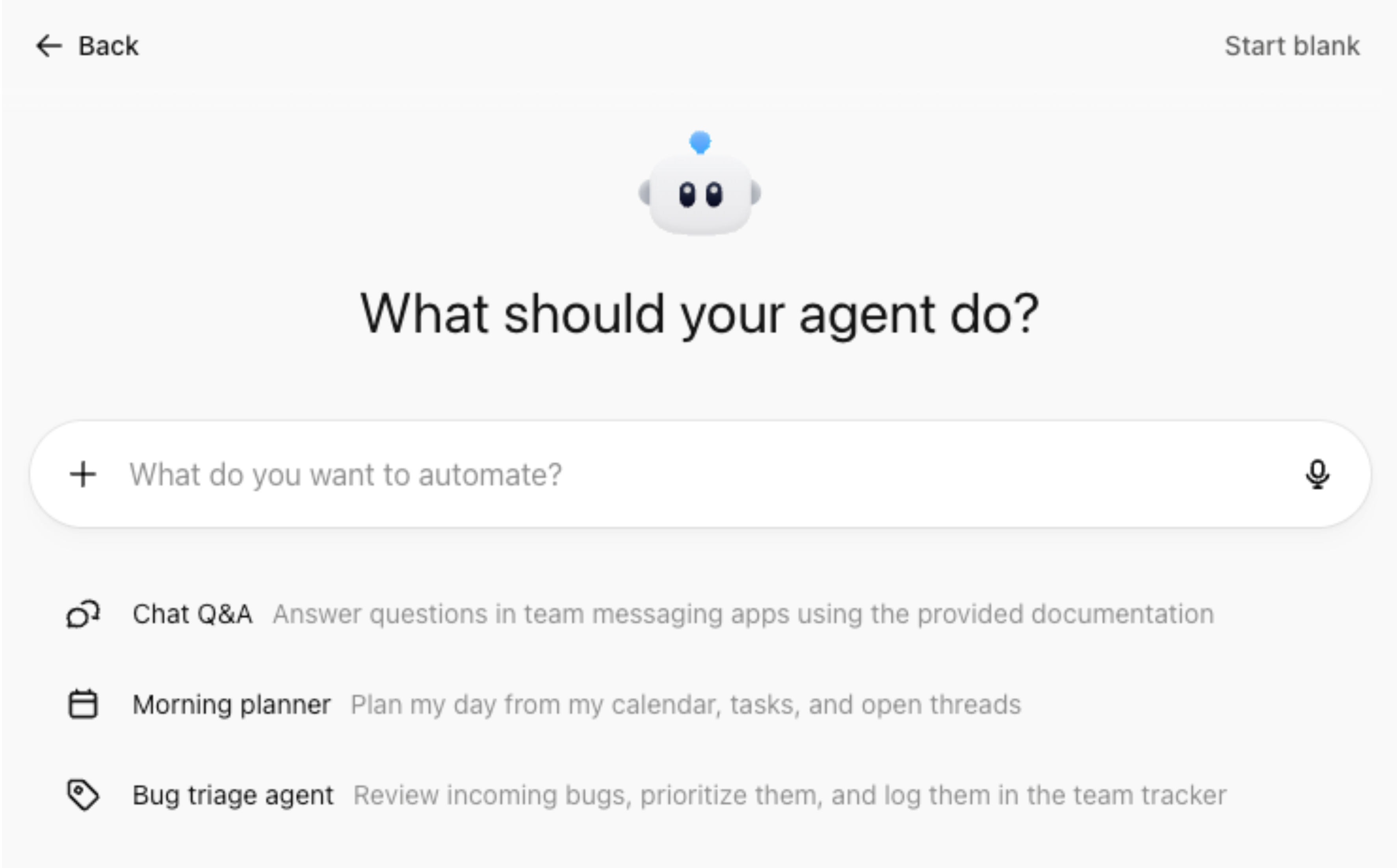
Official OpenAI product screenshot. It is included as interface evidence, not as a QuickSummit hands-on testing claim.
Workspace Agents have an important API limitation as of July 2026: a trigger returns 202 Accepted, but it does not return a run ID or let the caller retrieve the agent’s response through that API. That makes the feature suitable for fire-and-forget processes such as scheduled preparation or routing, but unsuitable when another application must immediately consume the output. OpenAI documents that limitation explicitly.
A custom API workflow removes that interface constraint. OpenAI’s API supports built-in tools, function calling, remote MCP servers, file search, and other components that can connect a model to business systems. The business must build or procure authentication, application logic, logging, evaluations, approvals, retries, and support. See OpenAI’s tools documentation and our broader comparison of custom agents and off-the-shelf automation.
The SMB Cost Model: Software, Implementation, Monitoring, and Human Review
Token pricing is measurable, but it is rarely the largest cost in a controlled business workflow.
Using OpenAI’s July 27, 2026 API rates, one million input tokens plus one million output tokens costs $7 with GPT-5.6 Luna: $1 for input and $6 for output. That excludes engineering, tools, monitoring, and human review. Source: OpenAI model comparison.
Consider a hypothetical invoice-triage workflow. This is transparent planning math, not a client result or savings promise.
Monthly assumptions
- 1,000 workflow runs
- 8,000 input tokens and 2,000 output tokens per run
- $300 for hosting, logging, alerts, and integration software
- Five monitoring hours per week at an assumed $75 internal cost per hour
- Human review of 10% of runs, taking five minutes each, at an assumed $40 per hour
- 80 initial implementation hours at an assumed $150 per hour
Calculation
- Model input: 8 million tokens × $1 per million = $8
- Model output: 2 million tokens × $6 per million = $12
- Model total: $20 per month
- Monitoring: 5 hours × 4.33 weeks × $75 = $1,624 per month
- Human review: 100 reviews × 5 minutes ÷ 60 × $40 = $333 per month
- Supporting software: $300 per month
- Initial implementation: 80 hours × $150 = $12,000
- Ongoing monthly total: $2,277, or approximately $2.28 per run
- First-month total including implementation: $14,277
In this model, token charges are approximately 0.9% of ongoing monthly cost. Changing the model price by 50% would move the monthly total by only $10; reducing monitoring or review without evidence could create a much larger operational risk.
Replace every assumption with your own measured volume, labor rate, exception rate, and review time. Our AI automation ROI framework explains how to compare that cost with capacity gained, errors avoided, and cycle time reduced.
For Workspace Agents, the comparable software floor is two ChatGPT Business seats: $40 per month when billed annually or $50 on monthly billing, before any additional usage, implementation, connector, or review costs. A Business-versus-API comparison can help separate seat economics from workflow economics.
A Build-vs.-Wait Decision Tree for SMBs
Use four questions:
-
Do you have an eligible enterprise relationship and a high-volume voice or chat workflow requiring managed governance? Ask your OpenAI account team to assess Presence. Do not assume eligibility or price.
-
Is the work internal, repeatable, and acceptable inside ChatGPT or Slack? Pilot a Workspace Agent. Keep write actions behind approval until the workflow passes documented tests.
-
Must another system receive the result, enforce custom logic, or present a branded customer interface? Build an API workflow. The current Workspace Agent trigger cannot return its result to the calling application.
-
Can nobody own the workflow, exceptions, and weekly review? Wait. Software selection cannot compensate for a missing process owner.
We generally favor Workspace Agents for internal research, preparation, summarization, and routing. We favor custom API workflows when the automation must sit inside a core system, return structured data, or support a customer-facing experience. Presence becomes relevant when deployment support and production governance are themselves part of the purchase.
What to Implement Now While Presence Remains Enterprise-Only
We implement a six-step pilot procedure for clients:
- Document one workflow’s trigger, inputs, permitted actions, exceptions, escalation owner, and success measure.
- Assemble 20 historical test cases: 15 routine cases and five exceptions.
- Start in read-only or draft mode. Require approval for any action that sends, edits, posts, purchases, refunds, or deletes.
- Log five fields for every run: input reference, output, tools used, approval decision, and final outcome.
- Run a two-week shadow pilot alongside the current process.
- Review every failed or escalated run plus a 10% sample of the remainder before expanding access.
This procedure creates evidence that will remain useful whether you eventually choose Presence, Workspace Agents, another vendor, or a custom API stack. Begin with a workflow-readiness audit, not with a product demo.
OpenAI Presence should be reviewed again if OpenAI expands access, introduces self-service, or publishes standardized pricing. If none of those events occurs, the next scheduled availability and pricing check for this article is October 22, 2026.
If you need help selecting the right path, QuickSummit can scope the workflow, build the cost model, and design a controlled pilot through our AI automation consulting services.